Created and developed by: Laura Venner
- Active Solar Energy
- The conversion of sunlight into electricity achieved through use of a solar panel or by heating a transfer fluid to produce steam to run a generator.
- Amino Acids
- Molecules that are critical to life that serve as the building blocks of proteins.
- Atmosphere
- The gaseous mass or envelope surrounding a celestial body, especially the one surrounding the earth, and retained by the celestial body’s gravitational field.
- Biology
- The science of life and of living organisms including their structure, function, growth, origin, evolution, and distribution.
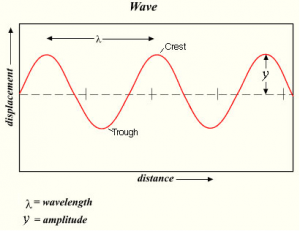
- Crest
- The top of a wave (see wavelength).
- Cryomagma
- Ice-volcanic melt, these substances are usually liquids and form plumes, but can also be in vapor form. After eruption, cryomagma condenses to a solid form when exposed to the very low surrounding temperature.
- Cryovolcano
- Icy volcano. Rather than molten rock, these volcanoes erupt volatiles such as water, ammonia, or methane.
- Cyanobacteria
- Bacteria which are aquatic and photosynthetic, that is, that live in water and can manufacture their own food – also called blue-green algae
- DNA
- Deoxyribonucleic acid; a very large molecule which carries genetic instructions for the biological development of all cellular forms of life and many viruses
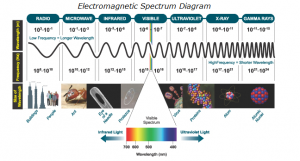
- Electromagnetic radiation
- Energy radiated in the form of a wave as a result of the motion of electric charges.
- Electromagnetic spectrum
- The entire range of light which includes the rainbow of colors we normally see.
- Exoplanet
- A planet outside of our solar system.
- Extremophiles
- Bacteria-like organisms living under conditions we consider extreme and uninhabitable.
- Genetics
- The branch of biology that deals with heredity, especially the mechanisms of hereditary transmission and the variation of inherited characteristics among similar or related organisms.
- Hydrothermal vent
- A crack along a rift or ridge in the deep ocean floor that spews out water heated to high temperatures (above 350°C [660°F] have been recorded) by the magma under the Earth’s crust.
- Kelvin
- A unit used to measure temperature; scale on which absolute zero, the coldest possible temperature, is zero kelvins (0 K).
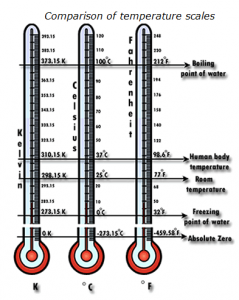
Temperature conversion table From To Fahrenheit To Celsius To Kelvin ºF — (ºF – 32) / 1.8 (ºF – 32) * 5/9 + 273.15 ºC (ºC * 1.8) + 32 — ºC + 273.15 K (K – 273.15) * 9/5 + 32 K – 273.15 — - Passive solar energy
- The capture of sunlight for radiant heat achieved through window placement and orientation of a building.
- Photon
- A discrete bundle of electromagnetic (or light) energy.
- Radiation
- The transfer of energy waves moving through space.
- Robotic explorer
- A robot designed to make scientific research measurements and usually under telerobotic control.
- Telemetry
- The science and technology of automatic measurement and transmission of data by wire, radio, or other means from remote sources, as from space vehicles, to receiving stations for recording and analysis.
- Telescope
- An instrument designed for the observation of remote objects and the collection of electromagnetic radiation.
- Telerobotics
- The area of robotics concerned with the control of robots from a distance, chiefly using wireless connections.
- Tidal heating
- The heating of the interior of one planetary body caused by stresses induced from the gravitational pull of another.
- Trough
- The bottom of a wave (see wavelength).
- Wavelength (Symbol: λ)
- The distance between two crests or two troughs of a wave